JoAnn Tangney: Funeral Homily, September 17, 2026

Mark 5:24-34

Healing

When we hear the story of the healing of this woman we tend to focus on the end, the moment she is healed.

But there are twelve years of suffering before this moment.

And of these twelve years, we are told only that she has endured much under many physicians, that she has spent all she has and was no better but rather grew worse.

We know nothing about how she spent her time during those twelve years of suffering.

Whether she sat at home doing nothing, listless, inactive, succumbing to despair

Or whether she had a family, children to care for, a house to organize; whether she cooked meals for them, found any pleasure in twelve years of suffering.

JoAnn suffered for many years too, and perhaps her the way she lived her life helps us to see in new ways.

Suffering didn’t define JoAnn.  

Though it limited her, it did not stop her from enjoying life but rather sharpened in her a sense of fight and of focus.

She did what she loved and what brought her deep pleasure.

Cooking splendid meals from scratch, without measuring, drawing on what she had been given her, passed down to her from her foremothers.  

How to set a table and gather around it, how to savor life around the table, family gathered with all the foolishness and joy that goes along with it.  

Life on a farm is a family affair, and JoAnn tended to that life also, bottle feeding calves and mucking about in her barn boots rain and shine.

She loved being with people; suffering didn’t change this.

She loved meeting people, getting to know the regulars, sharing stories and the news of the day.

Yes, she suffered and for too long, but suffering did not define her; she would not let it be the story of who she was as a person, who she was for her family, who she was in this community.  

No, she found a way to thrive despite all of that, and her family will tell you that she was a lot more than the illness she suffered, 

that when the diagnosis was bad news, she did not withdraw but focused on the life she loved, the people she loved, the people who say she was strong and resilient and undaunted.

She too suffered much at the hands of physicians, and got better sometimes, but over time grew worse.

But though she grew worse, she chose the better, 

to thrive through giving to her family, to celebrate the grandkids she loved so well; they tell JoAnn’s story, of how strong she was, how much fun she was, how she found ways to make all their lives better right on through her own suffering.  

In the end, the story of the woman whose years of suffering end when she reaches out and touches Jesus is also JoAnn’s story.

For both, the end is a beginning.

The end of suffering is healing.

One woman reaches out and touches Jesus’s clothes, but there are many ways to reach out, many forms of touch–

And in all of them, in the end…there healing begins.

Food and laughter and good hard work, the ways now we, as JoAnn did in her life, reach out to one another, take care of one another, give our lives to loving no matter our own suffering.

…in all of this there is healing, and by faith we believe that in this end, in the end of JoAnn’s suffering, she is healed.

She begins a new life, and so do we.

Thanks be to God.  
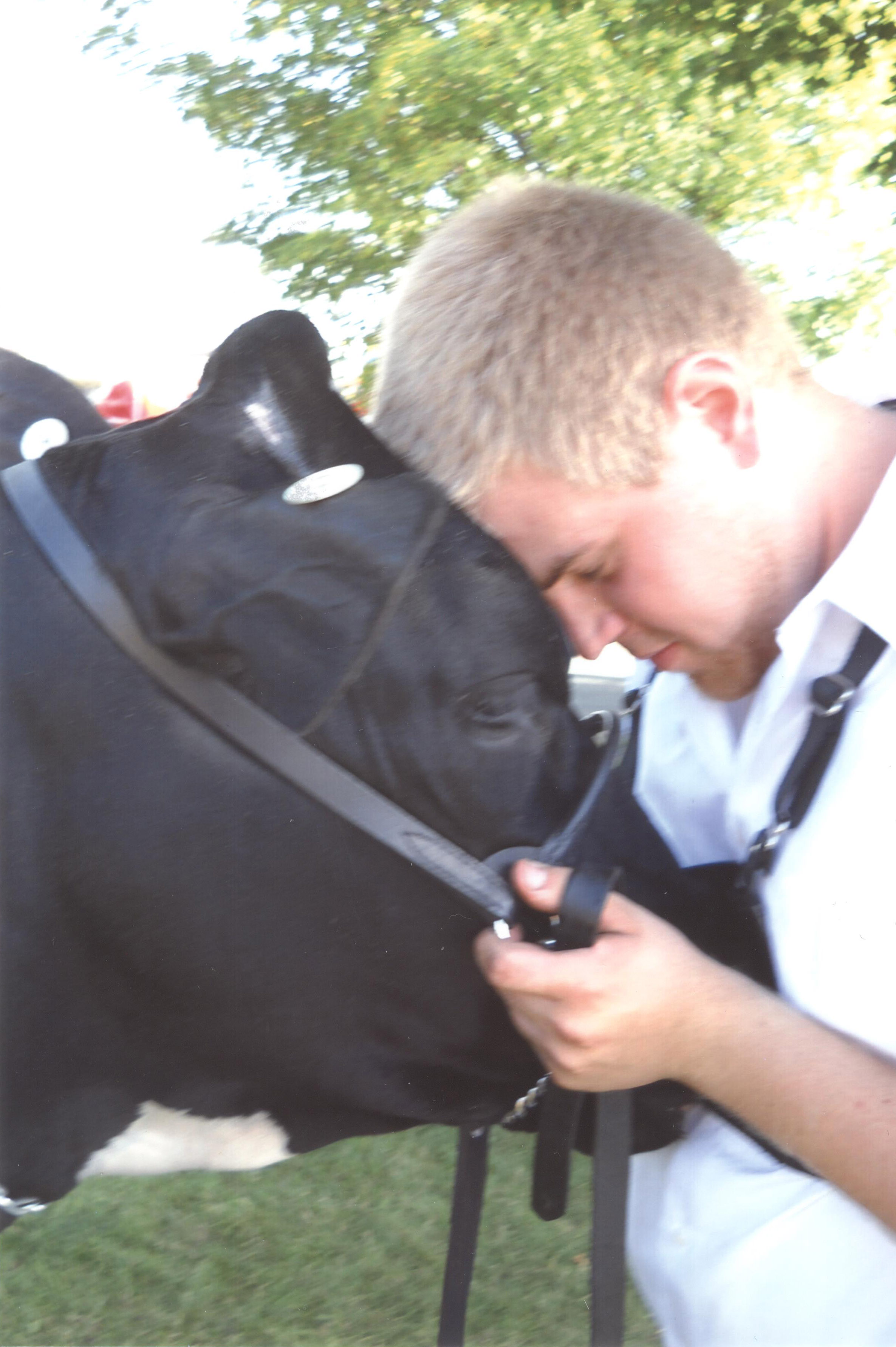
Homily: John Klossner Holstein Whisperer

John Klossner

John Klossner, October 8, 1993 – August 12, 2013

Holstein Whisperer
Luke 15:3-7

A few years ago, a movie came out called “The Horse Whisperer.”

The lead character’s name was  Buck—no surprise there.  The movie told the story of Buck’s special connection with horses, a connection that was rooted in who he was: his way with horses was a view into his soul.

It seems to me that a movie called “The Holstein Whisperer” could be made

The movie would open with a little boy playing at home with one of those farmyard play sets—a freckle-faced farmer with a hat wearing bib overalls, a tractor, several barnyard animals, a fence to lay out, and a barn with a door that would go “moooo” when opened.

As the scene opens, the little boy’s back is to the camera; he is hunched over working at something.

What is he working at?

Slowly, the camera rotates around to the front; the little boy’s mouth is set in concentration; as the camera zooms in we see that the boy has a bottle of White-Out and black Sharpees; he is changing the black and white patterns of the Holsteins, because, of course, the markings of Holsteins are as individual to them as fingerprints are to us.

The next scene would be the little boy in church wearing bib overalls and bright yellow barn gloves; his Sunday-go-to-meeting clothes.

As he grows, there would been countless scenes of him playing the barn and alone in the pasture with cows.  There would be scenes of the boy leading calves around and playing with them because they were his friends.

He would constantly ask question about Holsteins and remember everything he was told.  His family would celebrate and nurture his gift; he would work along side his father milking and feeding and caring for the herd;  his mother would encourage him to develop his gifts; older brother and sister would be delighted by his fascination with Hosteins.

He would go to Dairy Expos and Dairy Bowls and win too many honors and awards to name.

In time, he would begin to share his gift with others and help them along, as glad to see them learn and succeed as he enjoyed winning himself.  When he saw in other boys and girls that gift that he himself had, he would help them in every way he could, not only because this is what he had been taught to do, but because to help them was good for the breed.

There would be an intensity about him; a focus borne of lifetime of loving Holsteins.  He would know just how to “dial it in” so that would never come in “DFL.”

You all can write the script for this movie because you knew John.

Everything I know about showing cattle I learned by talking with the Klossners the last few days.  I know that part of showing and breeding is about confirmation—how well a cow conforms to the standards of the breed.  But it seems to me that there is something more to it, something that I hear is essential to the gift John was given.

It is about relationship.

John had a way of relating to Holsteins that was an expression of his very soul.  He was nice and kind and gentle.  His cattle felt comforted with him; safe in the hands of a young man who related to each individually, who understood each cow’s personality, who could read each movement.

And of course, the cows knew him as well as he knew them.  They had heard him singing to them when he did his chores; they felt his love and commitment to them in his touch.  When it came to showtime, they gave him their bovine trust because he had loved them from the time he had a bottle of White-Out and a black Sharpee marker.

You can’t fake relationship.  It develops over time.  It is about commitment; it is about trust.

You would need to talk with a Holstein expert, of which there are many here today, but I believe I can say with confidence that the breed had not yet been developed in ancient Palastine when Jesus told stories about God’s love to his disciples using sheep as an example.

Jesus talked to shepherds, not dairymen, so he told stories about sheep, not cattle, but what he says about God’s love for us makes sense in times like this.

Jesus tells stories to help us to trust our relationship with God.

The story might bear updating for today.

If you have a hundred head of cows, and one of them goes missing, you leave the 99 to go looking for the lost one.

God’s love for us is like that; it searches for us each individually when we are lost or in need or in pain or in sorrow.

Today, we are the 99 and John is the one.

He is the one lost to us but is found by God, who blessed John with special gifts, loved him from the beginning, and loves him in the end.

We have lost John, but God has found him.

But we are also the one today.

We are the ones who need to call on God and trust that he will find us, we are the ones who need now to trust our relationship with God, we are the ones who have questions to ask and fears to tell and frustrations to relieve.

And so we pray for faith in the coming days, that God will lead us, show us tender care, feed us and heal us, for we belong to God, and we can trust that God’s love will always find us, most especially when we feel lost and alone.

Now all the tax-collectors and sinners were coming near to listen to him.  And the Pharisees and the scribes were grumbling and saying, ‘This fellow welcomes sinners and eats with them.’

So [Jesus] told them this parable: ‘Which one of you, having a hundred sheep and losing one of them, does not leave the ninety-nine in the wilderness and go after the one that is lost until he finds it? When he has found it, he lays it on his shoulders and rejoices. And when he comes home, he calls together his friends and neighbors, saying to them, “Rejoice with me, for I have found my sheep that was lost.” Just so, I tell you, there will be more joy in heaven over one sinner who repents than over ninety-nine righteous people who need no repentance.