Unknown's avatar

About Craig McMahon

Angler on many levels.

Open and Affirming Certification Process

Note: Links to UCC and HRC resources are included at the end of this document.

History

A brief history of the beginnings of the Open and Affirming movement in the UCC began as a way churches certified and declared themselves ready to call pastors no matter their sexual orientation:

In 1972, Rev. William R. Johnson was the first openly gay minister ordained in the United Church of Christ. UCC members founded the UCC Gay Caucus, which later became the Open and Affirming Coalition.

In 1982, the Rev. Anne Holmes was the first openly lesbian minister ordained in the UCC.

In 1985, the ONA became a movement, with funding to manage and grow the movement toward congregations to be certified as Open and Affirming.   

In 1987, the first 15 congregations certified as Open and Affirming.

Over time, as more congregations became ONA, it became clear that LGBTQ people had come to feel rejected and shamed by congregations. The ONA certification process has come to represent much more than a congregation’s openness to call pastor’s no matter their sexual orientation.  ONA is understood as an essential commitment LGBTQ people, their families, and their friends. 

Not Alone

Other Christian denominations share this history. The ways they have responded are particular to their systems of governance, and the many variations in these denominations are too complex to enumerate.  The Human Rights Campaign provides an index of stances on ordination and inclusion of LGBTQ people.  This HRC index includes other faith traditions (eg, Muslim). 

Two Tracks for ONA Certification

There are two tracks for ONA certification.  One is for a congregation to undergo a process of discernment resulting in a congregational vote to approve an ONA covenant, the other is for a congregation to certify that it is already ONA in practice, so a process of discernment is not needed.

Process of Discernment for ONA Certification

The UCC ONA Coalition offers Building an Inclusive Church (BIC) Toolkit and an Open and Affirming Planning Guide.  The recommended steps in the ONA process detailed in these resources are summarized as a 16 step process.  

This 16 step process has been developed based on the experiences and needs of congregations embarking on this journey.  

Among the many steps outlined, there are three key outcomes: 

  • One, the congregation writes an ONA covenant (example covenants).
  • Two, the congregation develops a program to study and discuss ONA.
  • Three, the congregation takes a vote to certify the ONA Covenant.  

Upon vote for approval, the congregation reports the vote to the Wisconsin Conference, which then allows congregations to be designated as ONA for future Search and Call processes.  ONA congregations are also listed and searchable to people looking to find ONA churches. 

List of Open and Affirming Links

ONA Coalition Home Page:
https://openandaffirming.org/

Why Should My Church Become ONA?
https://openandaffirming.org/ona/why/

History of ONA
https://openandaffirming.org/about/history/

ONA Resources Page
https://openandaffirming.org/resources/issues/

Building and Inclusive Church (BIC) Toolkit 
https://openandaffirming.org/wp-content/uploads/2021/07/BIC_Toolkit_2021Edits.pdf

Open and Affirming Planning Guide with 16 Steps
https://openandaffirming.org/ona/how/guide/

Example ONA Covenants
https://openandaffirming.org/ona/how/covenants/

Searchable ONA Congregations Database
https://openandaffirming.org/ona/find/

Human Rights Campaign Links

Index: Human Rights Foundation Faith Resources
https://www.hrc.org/resources/faith-resources

United Church of Christ
https://www.hrc.org/resources/stances-of-faiths-on-lgbt-issues-united-church-of-christ

Presbyterian Church (USA)
https://www.hrc.org/resources/stances-of-faiths-on-lgbt-issues-presbyterian-church-usa

Lutheran Church (ELCA)
https://www.hrc.org/resources/stances-of-faiths-on-lgbt-issues-evangelical-lutheran-church-in-america

United Methodists
https://www.hrc.org/resources/stances-of-faiths-on-lgbt-issues-united-methodist-church

Episcopal Church
https://www.hrc.org/resources/stances-of-faiths-on-lgbt-issues-episcopal-church

African Methodists Episcopal Church
https://www.hrc.org/resources/stances-of-faiths-on-lgbt-issues-african-methodist-episcopal-church

Story of Hagar and  Ishmael: Sunday, June 25: Genesis 21:8-21

Isaac is born (Gen. 21:1-6), and when the time comes for him to be weaned, Abraham makes a great feast, and Hagar and Ishmael attend the celebration. When Sara sees Ishmael, who would have been about 15 years old, playing with his little brother, she demands that Abraham “cast out this slave woman with her son, for the son of this slave woman shall not inherit along with my son Isaac (Gen. 21:10b).   

Abraham is distressed by Sarah’s demand, as we discover with the first words God speaks to him, “Do not be distressed because of the boy and because of your slave woman” (Gen 21:12b), and God then promises to make a great nation of Ishmael also, because he is the offspring of Abraham.      

The disturbing result, then, is that Abraham takes Hagar and Ishmael out to the desert, gives them some bread and water, and abandons them there.

So Abraham rose early in the morning, and took bread and a skin of water, and gave it to Hagar, putting it on her shoulder, along with the child, and sent her away. And she departed, and wandered about in the wilderness of Beer-sheba. Gen. 21:14.

What follows in this story is devastating and moving—Hagar and Ishmael run out of water, and the boy’s cries are too heart-rending for her, so she sets him under a tree and moves far enough away so she doesn’t have to see to her son die:

When the water in the skin was gone, she cast the child under one of the bushes. Then she went and sat down opposite him a good way off, about the distance of a bowshot; for she said, ‘Do not let me look on the death of the child.’ Gen. 21: 15-16

What happens next is what we should expect but which still comes as a surprising relief: Hagar lifts up her voice and weeps; God hears and answers her prayers.

Do not be afraid; for God has heard the voice of the boy where he is. Come, lift up the boy and hold him fast with your hand, for I will make a great nation of him.’ Then God opened her eyes, and she saw a well of water. She went, and filled the skin with water, and gave the boy a drink. Gen  21:18-18.  

This part of the story of Ishmael ends with a hint at the future:

God was with the boy, and he grew up; he lived in the wilderness, and became an expert with the bow. He lived in the wilderness of Paran; and his mother got a wife for him from the land of Egypt.  Gen: 21:20-21

The fulfillment of God’s promise to Ishmael appears two times in Genesis. A genealogy of Ishmael descendants appears in Gen. 25:12-18.  And then later we find Ishmael stature rises so that a tribe of people are named after him—Ishmaelites.

Sarah Laughs

Gen..: Sarah laughed to herself, saying, "After I have grown old, and my husband is old, shall I have pleasure?"

Ps.: O LORD, I am your servant; I am your servant, the child of your serving girl. You have loosed my bonds.

Rom: hope does not disappoint us, because God's love has been poured into our hearts through the Holy Spirit that has been given to us.

Matt: When he saw the crowds, he had compassion for them, because they were harassed and helpless, like sheep without a shepherd.

Rev. Craig McMahon
Windsor UCC
A Pentecost +2; Outdoor Worship, Father’s Day; Genesis Study; 6/18/2023
Genesis 18:1-15, (21:1-7); Psalm 116:1-2, 12-19; Romans 5:1-8; Matthew 9:35-10:8, (9-23)

It seems especially fitting, in that unplanned things-just-work-out kind of way, that we read the story of Abraham the father of our faith. 

But perhaps also especially fitting is Sarah’s part in all of this….

This is not the first time God has made this same promise…nor does this singular moment tell the whole story…

Which any father worthy of the title will tell you….

What goes into fatherhood, into husbandhood, into parenthood, is a complex, winding story, to be sure, and at the heart of it are the Sarahs who work-work-work with our Abrahams to shape our lives and our future…..

That is the thing…The beginning of the story…the story of our first ancestors—Abraham and Sarah, Isaac and Rachel, Jacob and Rebekah, and then Joseph and his brothers…

In our beginning stories, our ancestors are anxious about their future, whether they will have one, before they have their own place, while they are living in tents, vulnerable aliens in a foreign land.

Anxiety over the future is the story of Abraham and Sarah’s childlessness…

How can they claim faith in their God if the story stops with them, their accumulation of wealth without any legacy, none at all?

Faith without fulfillment of promise.  

Not surprisingly, Sarah bears the burden of this…SHE is barren…the future depends upon her…a heavy burden to bear, especially given how much of a dreamer Abraham is, looking at the stars and believing that he will have more offspring than the stars in the sky…

Which, last time I checked, he cannot do alone…No… fathering is not something we do alone, no, not alone….

When the three travelers arrive, Abraham scurries about, going to his long-suffering wife to give her orders to cook up a big meal, which she does, and then he sits by his guests in the shade of the Oak trees, while Sarah, as if she were an obedient Southern Baptist woman, hides nearby in a tent listening to the men talking….

And then something happens again…yet again…A child is promised….again…

And she laughs…

Erupts into laughter?  Bursts into laughter?  Guffaws?  Howls?  

It is not a snicker, not a titer, but a laugh loud enough for the men to hear

The response of the three men is what we remember—they say…Is there anything too wonderful for the Lord?  

Which she takes as an accusation….

Responds as if she is guilty, denying she laughed, which is absurd—they all heard it…

Maybe it is something like getting the last laugh, you know, maybe she is laughing at them, at Abraham, at all this nonsense about HER having  a child….

Hah…as if…

Maybe her laughter tells the truth of how she feels about all of this, about what she has sacrifice and lost believing she has a future, will have a child, that Abraham is capable of fathering a child with her

Can we blame her?

The first time this promise was made long before this, 

When she and Abram were already too old for children, to have a future, 

The promise made to Abraham—look at the stars and count them, if you can count them, so will your dependents be…as if he can do it alone…but she believed and she tried, they tried and failed, for years they tried and failed, until at last she is filled with despair and self-loathing, 

So, God bless her…She blames God.

She says that God has prevented her from having a child…

And so she takes matters into her own hands, makes her own plan, since God has failed her…desperate to create a legacy and a future, she “gives” an Egyptian slave, a girl named Hagar, to Abraham to have a child with, something like surrogacy I suppose, and Abraham…complies?

We have no way of understanding how these kinds of arrangements worked in the ancient world (people who talk about traditional marriage certainly don’t cite Abraham and Sarah and Hagar as examples) It looks to me like Abraham missed an opportunity here, 

…should have said to Sarah: “No my love, no: we can trust the promises of God us, you are part of that promise; we will have a child together, as God has promised us together, you and me together, as God said, as many as the stars in the heavens, remember?”  

Alas, when Hagar becomes pregnant, Sarah is angry.  Hagar’s pregnancy proving Sarah not Abraham is the “problem,”

In her distress, she takes out her own sense of shame on poor Hagar, who has no choice in the matter, none at all….And still long before the laugh, years before the laugh, after Hagar has given birth to Ishmael, when she and Abram are yet older, God comes to make a promise yet again, this time giving a sign of the covenant with Abraham and Sarah, giving them their new names….

Through all of this time passes, and she and Abraham get older, and in all the promises there is nothing but promises, empty promises, barren promises.

And all of this shame and contempt and frustration and emptiness is contained in Sarah’s laugh….somehow…

Hah!  

Because it is absurd to believe it?To protect herself from believing it? Because she has suffered so much already, her trust has been broken. It is not just that it is too late but that she can’t keep pretending anymore, is not going to play along with this nonsense anymore? 

Hah!

God bless all our Sarahs and all they has given, have suffered, for the ways they have carried the burden of the promise…

The ways in good faith they have tried and tried and continued to believe and maintained faith in the promise of God through all the hardships they have endured, 

Yes, of course, we know how the story will end.

We are here on this lovely Sunday, we ourselves are offspring of Abraham and Sarah, our first ancestors, we are the countless stars of God’s first promise to Abraham, and we are Sarah’s laughter…..

Is there anything too wonderful for God?  No, of course, no, there is nothing to wonderful 

But there is much that  is too wonderful for us, because like Sarah we have endured much, suffered much, believed and given and blamed ourselves when things don’t go as planned, as we pray they will go, 

When God’s timing is too long and violates our own sense of timing, when we feel too old and too used up look for  for some young Hagar to force into labor…You do the work if you think you can do it better…I am done and my future is behind me…I have given all I have to give and and used up and played out—nothing new will happen.  I am barren of hope and have lost all faith that anything new and good will be borne of me.  

The anxieties we suffer as modern believers about our own future, the future of our families, the future of our church, the future of our nation and our national politics, of what it means for us to believe in the promises of God in Christ new life will emerge, children of God, disciples of Christ…these anxieties are not new, not new all all, 

This is how the story begins, our Genesis story, and for us as for our first ancestors.

Is anything too wonderful for God…

Still later, long after Sarah’s laugh, Isaac is born…

His name a play on words, translate to HE WILL LAUGH.

A testament to what she suffered through to give birth to the future, 

Her bitter laughter transferred into joyful laughter, a future, a legacy..

Is there anything too wonderful for our God?

A Reading from the Book of Genesis

The Lord appeared to Abraham by the oaks of Mamre, as he sat at the entrance of his tent in the heat of the day. He looked up and saw three men standing near him. When he saw them, he ran from the tent entrance to meet them, and bowed down to the ground. 

He said, ‘My lord, if I find favor with you, do not pass by your servant. Let a little water be brought, and wash your feet, and rest yourselves under the tree. Let me bring a little bread, that you may refresh yourselves, and after that you may pass on—since you have come to your servant.’ 

So they said, ‘Do as you have said.’ And Abraham hastened into the tent to Sarah, and said, ‘Make ready quickly three measures of choice flour, knead it, and make cakes.’ 

Abraham ran to the herd, and took a calf, tender and good, and gave it to the servant, who hastened to prepare it. Then he took curds and milk and the calf that he had prepared, and set it before them; and he stood by them under the tree while they ate.

They said to him, ‘Where is your wife Sarah?’ And he said, ‘There, in the tent.’ Then one said, ‘I will surely return to you in due season, and your wife Sarah shall have a son.’ 

And Sarah was listening at the tent entrance behind him. Now Abraham and Sarah were old, advanced in age; it had ceased to be with Sarah after the manner of women. 

So Sarah laughed to herself, saying, ‘After I have grown old, and my husband is old, shall I have pleasure?’ 

The Lord said to Abraham, ‘Why did Sarah laugh, and say, “Shall I indeed bear a child, now that I am old?” Is anything too wonderful for the Lord? At the set time I will return to you, in due season, and Sarah shall have a son.’ 

But Sarah denied, saying, ‘I did not laugh’; for she was afraid. 

He said, ‘Oh yes, you did laugh.’

The Lord dealt with Sarah as he had said, and the Lord did for Sarah as he had promised. 

Sarah conceived and bore Abraham a son in his old age, at the time of which God had spoken to him. Abraham gave the name Isaac to his son whom Sarah bore him. 

And Abraham circumcised his son Isaac when he was eight days old, as God had commanded him. 

Abraham was a hundred years old when his son Isaac was born to him. Now Sarah said, ‘God has brought laughter for me; everyone who hears will laugh with me.’

 And she said, ‘Who would ever have said to Abraham that Sarah would nurse children? Yet I have borne him a son in his old age.’

Skipping Over Shame Gen 18:16-20:18

Gen 18:16-20:18

These chapters and verses include some of the most troubling, complex, and misunderstood stories in the bible.

The judgment of Sodom and Gammorah, incestuous relationship between Lot and his daughters, which produces the Moabites and Amorites, and  Abraham and Sarah traveling, with Abraham passing off Sarah as his sister, which puts her in danger, along with the household that takes her in.  

There is a lot of shameful behavior in these chapters in all the actors.  

What has been most often selected and read from and preached on in this section of scripture is Abraham bargaining with God (Gen 18:22-33).  This brief passage seems to convey a sense that Abraham understands God as merciful and reveals an admirable  aspect of Abraham’s character.  

Backstory: Genesis 15, 16, 17

The backstory of the visit of the three men and promise of Isaac includes chapters 15, 16, and 17 of Genesis.  And there is a lot of trouble between the promise of Chapter 18 and the fulfillment of Chapter 21.  

Genesis Chapter 15: The promise of a child is made long before the visit of the Lord at the Oaks of Mamre. It could be that Sarah’s laugh is less about her physical condition and the status of her relationship with Abraham than it is how absurd it seems for God to make such a promise after having failed to make good on the original promise of chapter 15. 

Notice that the promise made in Chapter 15 is given to Abram and Sarai. They have not received new names yet. To receive a new name is to transition to a new state of being, which happens often in the Old Testament (as with Jacob becoming Israel) and in the New Testament (as with Simon becoming Peter, and Saul becoming Paul).  

Genesis Chapter 16: Sarai has given up on having a child, given up on trusting the promise of God, and in fact blames God for failing her:  ‘You see that the Lord has prevented me from bearing children (Gen. 16:2b).  She then takes matters into her own hands by “giving” her Egyptian slave, Hagar, to Abram, so they will not remain childless. Jealousy and envy lead Sarai to abuse Hagar when she becomes pregnant. She goes to her husband to complain, but Abram makes no effort to involve himself in any way, simply telling Sarai to do whatever she wants to Hagar; thus Hagar runs away to escape Sara’s abuse.  

What then happens is a story we do not often tell.  

An angel visits Hagar and promises to make a multitude of people from her offspring, the same promise given to Abram and Sarai. 

Genesis Chapter 17: The covenant with Abram and Sarai so far has been of words only. In Chapter 17, God gives Abram and Sarai their new names–Abraham and Sarah–and gives them a sign to mark the covenant with them, and oh what a sign–circumcision!

All of the males, Abraham himself and all of the males in his household, including his 13 year old son, Ishmael, suffer circumcision.  We pass over this covenant without much curiosity, but what is it about circumcision that makes sense as a sign of God’s covenant with Abraham?  Is it somehow related to the nature of the covenant itself, having to do with procreation? 

And women are left out altogether. 

What kind of power and authority does Abraham have to be able to insist that all males be circumcised? 

In any case, circumcision as a sign surely dispels the idea that covenant with God is easy, requiring no change, no sacrifice.

Is There Anything Too Wonderful for the Lord? Genesis 18:1-15, 21:1-7

Sunday, June 18: Genesis 18:1-15, 21:1-7

In Sunday’s reading (June 18, 2023), the Lord visits Abraham in the form of three men.  

Abraham prevails upon them to stay awhile, rest, and have a meal, and then runs to Sarah to give instructions for a grand meal. He slaughters and prepares his best animals for his guests.  .

The three sit in the shade under the Oaks of Mamre and wait, until at last Abraham brings them the food and stands by them as they eat.  

After the meal, they ask about Sarah, who listens from a tent nearby. They promise to return and that Sarah will bear a son, which is just too fantastical: she laughs right out loud—they are too old for that kind of relationship.  

To which they respond, “Is there anything too wonderful for the Lord?”

The lectionary for Sunday skips over three challenging chapters of Genesis to the birth of Isaac, the fulfillment of the promise.  

The Story Begins

The word genesis is rich with meaning–it marks the beginning not of random or chaotic happenings, but of a coherent story–a series of causally related events undertaken by characters in conflict.  Meaning arises from this conflict, how it is resolved or left unresolved, what the conflict itself reveals about the characters.. 

The book of Genesis is much more than merely the creation stories featuring Adam and Eve, Cain and Abel.  Genesis tells stories of the birth of faith through our first ancestors, beginning with the first family–Abraham and Sarah and Hagar, Ishmael and Isaac–and ending with Joseph forgiving his brothers, dying in in a Egypt, his last words promising that God will deliver them, and requesting his bones to be taken to the Promised Land (Gen. 50:24-26).

This summer is a good time to consider what Genesis means to us, how we find meaning and discern the ways God is at work in our lives and in the world.  

I invite you to join me in reading and studying Genesis through the summer.  We will read lectionary texts from Genesis every week, but these texts skip over stories that expose the characters in high moments we read on Sundays as they struggle through low times and behave less than admirably.  These low times sharpen and heighten the high moments, and help us better understand what it means for us to live faithfully when we ourselves struggle.  

There are several options to participate.

  1. To receive notes by email and to participate in an online discussion,
    subscribe to this blog (top right).
  2. To  receive notification of posts by text,
    >>>subscribe online here<<<.
  3. To follow posts on Facebook (with no discussion),
    follow our Facebook page: https://www.facebook.com/windsorucc1

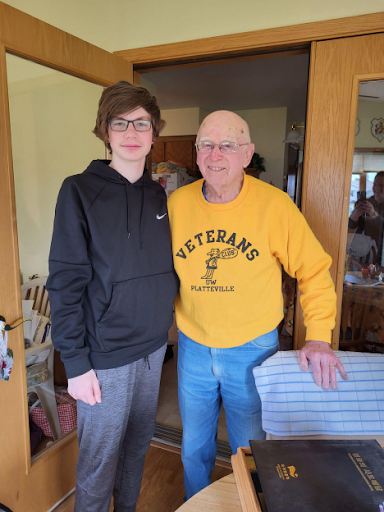
Joe Disch

Interview by Luke Sather, Confirmand

Where were you born?
New Glarus wi on a farm

Where were your parents from?
Mom-Blanchardville
Dad-New Glarus

What did your parents do?
Mom- housewife
Dad-farmwork

Where did you go to school?
One-room country schoolhouse


When were you confirmed?
June 7, 1953

How many were in your confirmation class
One

What were confirmation classes like/what did you do?
A sit-down session with the pastor

Which pastors do you remember?
Reverend Chudy

Do you have any children? 
Two boys; One girl

Where are they now,?
Oldest (Boy)- Alabama
Middle (Girl)- Marshfield
Youngest (Boy)- Sun Prairie

Grandchildren?
Six grandchildren, and four  great-grandchildren

What sports did you enjoy growing up and now?
Basketball
Softball
Golf

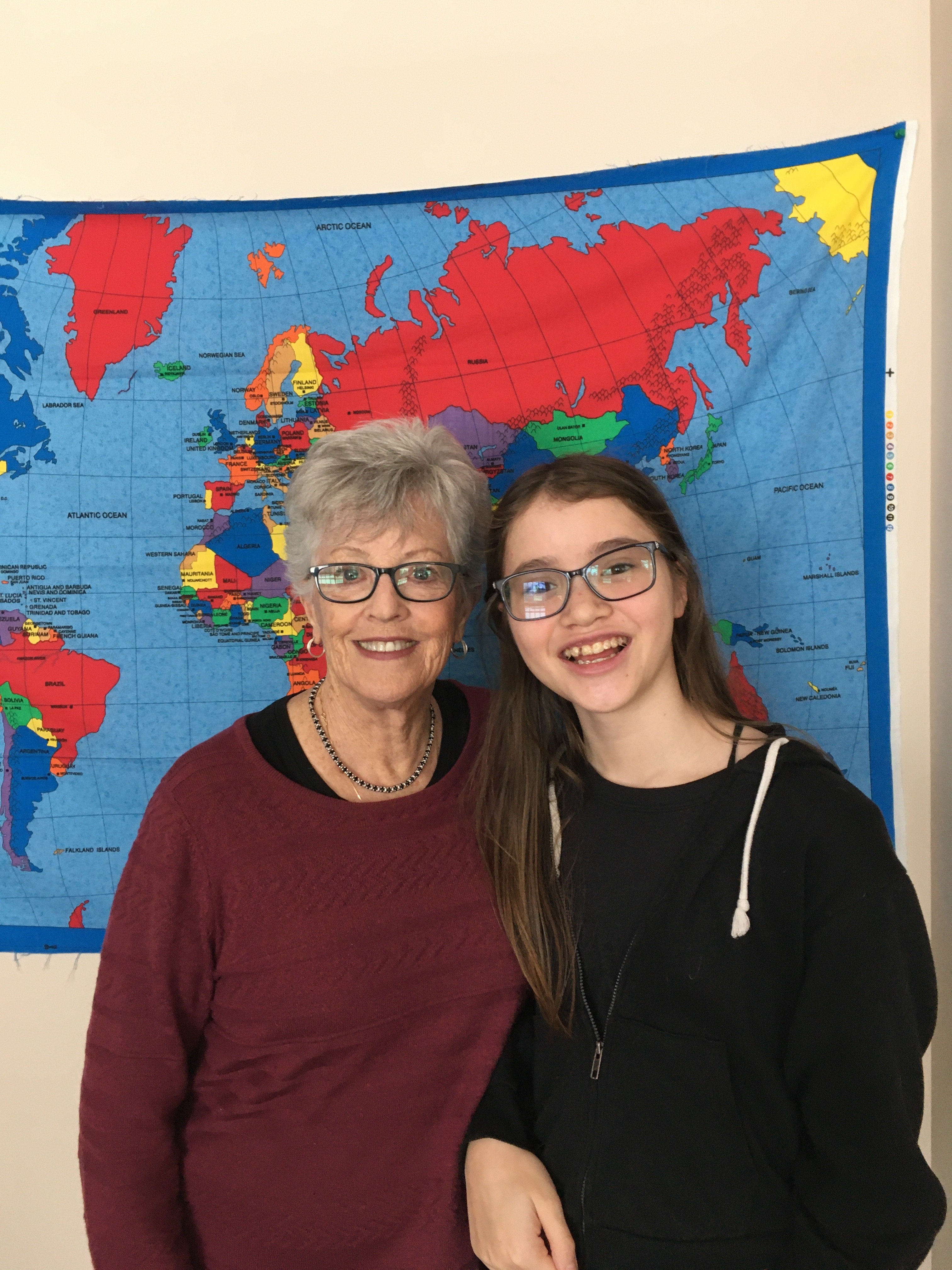
Kit Thomsen

Interview by Makena Lisowe, Confirmand

Kit was born in Ann Arbor Michigan. Her parents were both from Michigan, her mom was a housewife, and her dad was an insurance salesman. She grew up and went to school in Ann Arbor. She was involved in her church’s youth group, and would sometimes attend church. Luckily, no one in her family had to serve in the military during a war, but she mentioned that her husband served in the navy during peacetime. Even though she remembers Sunday school, she unfortunately doesn’t have much memory of confirmation. She says that she doesn’t remember ever getting confirmed, and she might not have.

Kit went to Central Michigan University, and got a degree in teaching, where she later on became a teacher for a while. She also had owned a retail business, which sold quilting supplies. She also lived in Chicago, and she moved to Wisconsin because of her husband’s job. She started at a congregational church when she moved here, but eventually came to Windsor UCC. She says the pastors she remembers are Dave Moyer, Dan Randall, Marty Balmer and David McDonald.

She has three children, Mark, Julie, and Sarah. Mark is a consultant, Julie does nutritional work for dairy cattle in her dads business, and Sarah works at Eveco. She has eight grandchildren, most of them in college. Her husband, Tom, worked as an accountant, and helped with his dad’s business, which Julie now works in.

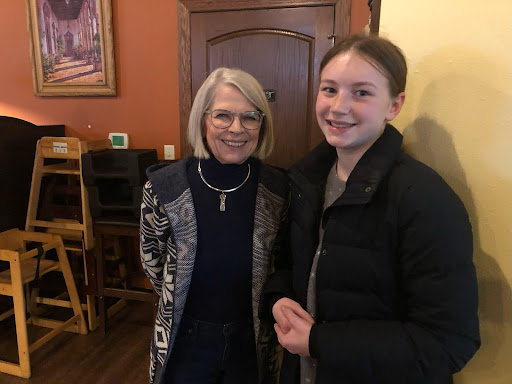
Joan Rice

Interview by Hailey Sutherland, Confirmand

Joan Rice was born November 5, 1949 near Green Bay. She lived there for the first few years of her life. She was one of eight children. Her dad owned a jewelry store and her mom stayed home with her and her siblings. Both of her parents died at a very young age. She went to a few Catholic schools. She went to Sacred Heart for elementary. For intermediate school she went to Xavier high. She attended UW Madison for college. She was confirmed in 7th grade, with all of the kids in her class which was about 30 to 40 . In her confirmation class she had to memorize a lot, also the bishops came to help with confirmation. The one pastor Joan remembered was Pastor Schmidt.

Joan has two children and they both live in California. Sara is the oldest, and has a talent agency. She also teaches workshops about the arts, and nature education. Sara also has a 16 year old son named Riker. Her other child Nick does background acting. Joan has lived in many different places in Wisconsin. Those include Green Bay, Appleton, Spooner (Which is up North), Madison and now Deforest.

Joan and I went to El Charro for dinner and conversation. Joan is very nice and easy going. This interview was great because I met someone new. I felt the interview could not have gone any better because we were similar people. I would love to do it again.